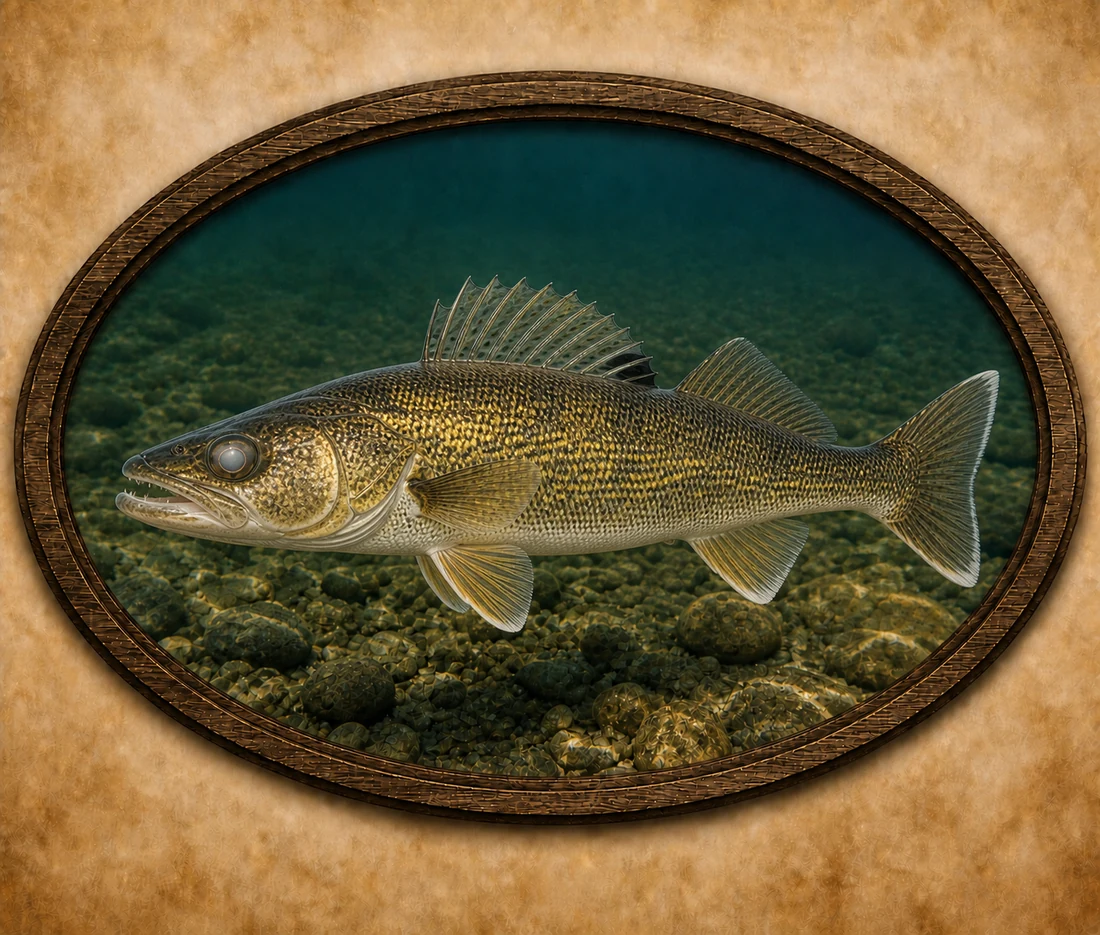
Why Target Them
Walleye have two legal identities in Utah. In reservoirs like Utah Lake, Starvation and Yuba they are a prized sport fish under the statewide limit of 10, only one of which may be over 24 inches, though some waters set their own number: Willard Bay allows 6. In the Green and Colorado rivers they are treated as a threat to native fish, and anglers may not release them; they must be killed. Know which water you are on before you unhook anything.
Field Biology
Why this fish does what it does — and what each fact means for your next cast. Sources listed at the end of the section.
A walleye's eye is built around green. Measured spectral sensitivity is broadest from 500–550 nm and peaks near 525 nm. Behind the retina sits a tapetum lucidum — a mirrored layer that bounces light back through the photoreceptors for a second pass. It is the same structure that flares a deer's eyes in headlights, and it is why a walleye's eyes glow gold in a flashlight beam. It buys them working vision in light their prey cannot use.
Here is the part most anglers have backwards. Walleye are not a pitch‑dark fish — they are a twilight fish. In controlled trials, prey capture success peaked at 20.5% between 0.05 and 1 lux, the narrow band running from nautical to civil twilight. In brighter light and in total darkness it fell to 10–12%. Their reaction distance tells the same story: 12 cm in full dark, rising to 27–30 cm at civil twilight.
Young walleye start on insects, then graduate to leeches, snails, crayfish and frogs — but grown fish eat mainly other fish. In Utah you do not have to guess at the forage base, because the regulations spell it out: DWR permits dead yellow perch as bait at Deer Creek, Starvation, Utah Lake, Willard Bay and Yuba. That is the state naming the primary menu item at exactly the waters that hold walleye.
Walleye are a coolwater fish that spawn at roughly 45°F. In Utah that window runs late February through mid‑May and moves with elevation — Willard Bay and Yuba go first, Utah Lake shortly after, high country last. Spawning fish push into 1 to 20 feet over rock, cobble and gravel. Utah's standing record, 15 lb 9 oz and 31¾ inches, came out of the Provo River in 1991.
Water eats color with depth, and it does not eat every color at the same rate. Set the water and the depth below. The top swatch is your lure in the shop; the bottom swatch is roughly what reaches the fish — and the bar scores how sharply it separates from the background through a walleye's green‑weighted eye, not yours.
A model, not a measurement — absorption and backscatter are approximated from published light‑attenuation curves and walleye spectral sensitivity. Treat the ranking as a way to think about colour, not gospel.
How To Catch Them
Where: Willard Bay, Utah Lake, Starvation, Deer Creek, Yuba
Go-to rig: Bottom-bouncer + worm harness; jig + minnow/plastic
Best bait and lures: Nightcrawler harnesses, curly-tail grubs, jerkbaits at night
Best time: Low light - dawn, dusk, after dark; spring spawn run
Fish slow along rocky points and dike edges. Best eating in Utah.
Your Loadout 🎣 Stock Up on Gear
Tackle + Bait Slots
Also works: curly-tail grubs · jerkbaits at night
The all-round reservoir kit: enough backbone for wind and depth.
Where To Catch Them (6 waters)
Lake Powell · Willard Bay · Utah Lake · Deer Creek Reservoir · Starvation Reservoir · Yuba Reservoir
Quick Answers
- How do you catch Walleye in Utah?
- Go-to rig: Bottom-bouncer + worm harness; jig + minnow/plastic Best bait: Nightcrawler harnesses, curly-tail grubs, jerkbaits at night
- Where can I catch Walleye in Utah?
- Lake Powell, Willard Bay, Utah Lake, Deer Creek Reservoir, Starvation Reservoir, Yuba Reservoir.
- When do Walleye bite best?
- Low light - dawn, dusk, after dark; spring spawn run
- Why fish for Walleye in Utah?
- Because walleye are the best table fish in Utah and they feed when almost nothing else will. That low-light habit is why people who fish for them in bright midday sun go home empty. The state record, 15 pounds 9 ounces, came out of the Provo River in 1991, not a reservoir.