Why Target Them
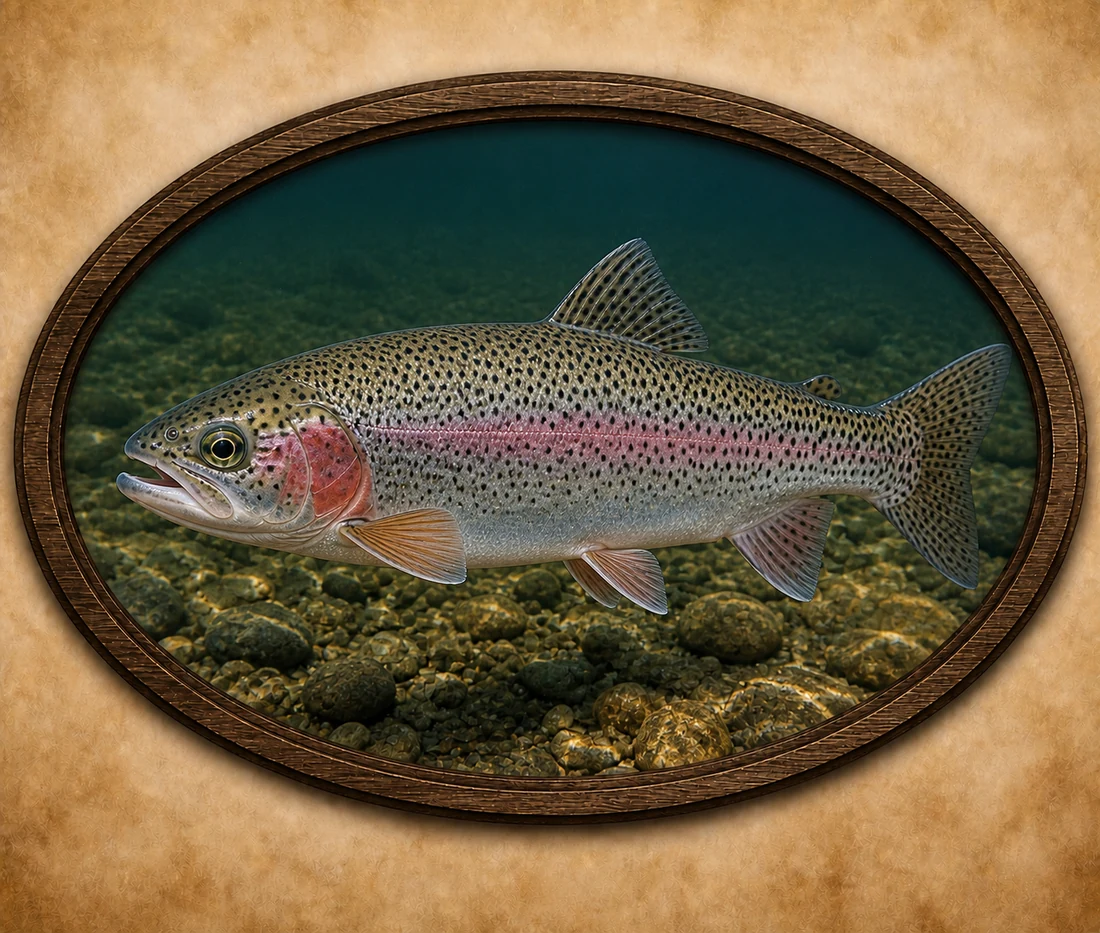
Rainbow trout are the fish Utah manufactures on purpose. The DWR's 13 hatcheries put out close to 10 million fish a year, from fingerlings up to 12-inch catchables, which is why a roadside pond can go from empty to loaded in a single morning. Check the DWR stocking report before you drive anywhere, because timing matters more than technique here. And note that community waters carry a 2-fish daily limit, not the statewide 4.
Field Biology
Why this fish does what it does — and what each fact means for your next cast. Sources listed at the end of the section.
A rainbow runs four cone types where a walleye runs two: ultraviolet near 365 nm, blue near 434, green near 510 and red near 565. A walleye has no blue channel and no UV channel at all. But the trout's UV channel is temporary — at smoltification thyroid hormone switches it off, and the gene signal disappears within about three days of that hormone rising. It is not quite permanent: a patch of retina looking down‑and‑forward keeps its UV cones for life, and a thyroid surge at maturity can regrow them elsewhere in the eye.
A trout is a drift feeder. In the classic study its stomach contents matched the composition of the drift — what floats past — and not the benthos, what crawls on the bottom. They eat what the current delivers. And in summer a large share of that delivery fell in from dry land: in headwater streams 40–50% or more of summer food can be terrestrial insects. That input peaks precisely when aquatic insect biomass hits its yearly low. The two are out of phase, and the hoppers fill the trough.
Adult rainbows hold in water that is much slower than anglers assume — a focal‑point velocity of roughly 0.33 to 0.46 ft/s, rarely beyond 0.72. But they hold that slow water immediately beside fast water. The fast lane is the conveyor belt; the slow pocket is the chair. Sitting in the current itself burns more than the current delivers, so the fish optimises net energy, not gross food. Boulder pockets are a cheaper lie than the average speed of the run suggests.
Whirling disease has been in Utah since 1991, first found in private hatcheries in the Fremont River drainage. Among the species living here, rainbow trout are the most susceptible — ahead of kokanee, golden, cutthroat, brook, brown and splake. Infected young fish may whirl, blacken at the tail, or die outright; survivors can carry twisted spines and deformed heads. DWR lists detections in Cache, Weber, Beaver, San Juan, Summit and Sevier counties.
In summer a trout does not have a lure problem, it has an oxygen problem. Warm water holds less dissolved oxygen at exactly the moment a fought fish needs more of it — that double squeeze, not heat alone, is what kills released trout. Set the water temperature and see where the fish actually is.
Utah has no temperature‑triggered closure — UDWR advises rather than prohibits, recommending morning sessions, deeper and cooler water, barbless single hooks, short fights and releasing without lifting the fish clear of the water. A stream thermometer is the most useful cheap thing in a vest.
How To Catch Them
Where: Stocked nearly everywhere - community ponds, reservoirs, streams
Go-to rig: Slip-bobber or sliding sinker rig, 4 lb mono line, size 8-10 baitholder
Best bait and lures: PowerBait (rainbow/garlic), nightcrawler, small spinners (Panther Martin, Jake's)
Best time: Early morning & last 2 hours before dark
Utah's #1 fish. If a pond got stocked this week, cast anything shiny. Perfect first fish for kids.
Your Loadout 🎣 Stock Up on Gear
Tackle + Bait Slots
Also works: nightcrawler · small spinners (Panther Martin, Jake's)
The all-round reservoir kit: enough backbone for wind and depth.
Where To Catch Them (60 waters)
Strawberry Reservoir · Flaming Gorge Reservoir · Fish Lake · Jordanelle Reservoir · Deer Creek Reservoir · Starvation Reservoir · Scofield Reservoir · Rockport Reservoir · Echo Reservoir · East Canyon Reservoir · Hyrum Reservoir · Mantua Reservoir · Lost Creek Reservoir · Provo River (Middle) · Provo River (Lower) · Green River (Section A) · American Fork Creek · Duchesne River · Sevier River (Upper) · Panguitch Lake · Otter Creek Reservoir · Minersville Reservoir · Navajo Lake · Kolob Reservoir · Palisade Reservoir · Yuba Reservoir · Quail Creek Reservoir · Baker Reservoir · Enterprise Reservoirs · Mirror Lake (Uintas) · Steinaker Reservoir · Red Fleet Reservoir · Millsite Reservoir · Piute Reservoir · Wide Hollow Reservoir · Salem Pond · Spring Lake (Payson) · Highland Glen Park Pond · Manila Creek Pond · Spanish Oaks Reservoir · Vivian Park Pond · Burraston Ponds · Payson City Ponds (Memorial Park) · Bountiful Pond · Farmington Pond · Kaysville Ponds · Jensen Nature Park Pond (Syracuse) · Steed Pond (Clearfield) · Glassmans Pond (Ogden) · Fort Buenaventura Pond · Willow Pond (Murray) · Sandy Urban Fishery · Millrace Pond (Taylorsville) · Grantsville Reservoir · Settlement Canyon Reservoir · Vernon Reservoir · Logan River 1st-3rd Dams · Tawa Ponds / Razor Ridge (St. George area) · Skyline Pond (Cedar City area) · Wellsville Reservoir & Hyrum-area ponds
Quick Answers
- How do you catch Rainbow Trout in Utah?
- Go-to rig: Slip-bobber or sliding sinker rig, 4 lb line, size 8-10 baitholder hook Best bait: PowerBait (rainbow/garlic), nightcrawler, small spinners (Panther Martin, Jake's)
- Where can I catch Rainbow Trout in Utah?
- Strawberry Reservoir, Flaming Gorge Reservoir, Fish Lake, Jordanelle Reservoir, Deer Creek Reservoir, Starvation Reservoir, Scofield Reservoir, Rockport Reservoir.
- When do Rainbow Trout bite best?
- Early morning & last 2 hours before dark
- Why fish for Rainbow Trout in Utah?
- Because they are everywhere and they are easy. Utah stocks rainbows in community ponds, big reservoirs and rivers alike, so a kid with a worm and a cheap rod has a real shot. They also grow: the state record rainbow, 26 pounds 2 ounces, came out of Flaming Gorge in 1979.